Ad Transparency Made Simple
📊 Build a solid compliance log, and see how boomers have gone majority online

Hey there 🧠
Ready for another day of staying ahead of the competition in the Growth race?
Oh and before we go ahead! If your friend sent this to you, be sure to subscribe here! So you don’t miss out on any editions.
Partnership with Wing Assistant
Get Back 20+ Hours Every Single Week with Wing
You know the trap. You start Monday with big priorities, and by Wednesday, you’re buried under inbox fires, calendar chaos, vendor follow-ups, and tasks that generate zero lift. Those lost hours add up. So do the missed targets.
There’s a cleaner path. Wing high-performing, trained human virtual assistants who absorb the operational drag and give you back the bandwidth you actually get paid for.
• 20 to 30 hours reclaimed weekly across admin, scheduling, CRM, and research
• 35% faster project cycles because your follow-ups and reporting run on autopilot
• 50% reduction in task switching, freeing you to focus on real work
With 10K+ customers and a 4.9 average rating, it’s built for operators: zero training, zero micromanagement, zero onboarding friction
If you had an extra 20 hours next week, what would you build? What would you finally fix?
Get matched with a high-performing assistant and buy back your time today!
💡 How to Use Meta and Google Ad Libraries for Transparency and Compliance
Running ads is not enough anymore. In 2025, brands are expected to prove who funded each impression, how disclosures were handled, and whether campaigns meet evolving platform and regulatory standards. Meta and Google now offer public ad libraries that double as compliance and brand trust tools.
1️⃣ Why Transparency Matters in 2025: Regulators, platforms, and consumers want clear accountability. Rules like the Digital Services Act are pushing advertisers to document how ads are funded, labeled, and distributed. Transparency libraries are no longer optional research tools. They are an audit infrastructure.
2️⃣ Which Ad Libraries to Monitor: Meta and Google each provide a different angle of verification.
• Meta Ad Library covers Facebook, Instagram, and Threads, and helps confirm what ran and whether labels like paid partnerships were applied correctly.
• Google Ads Transparency Center covers Search, YouTube, and Display, and helps verify advertiser identity and paid activity. Google’s 2025 improvements also display the payer name from the billing profile, creating a clearer funding trail.
3️⃣ What to Track in Every Audit Log: A defensible compliance program depends on consistent documentation. At minimum, log:
• Advertiser name
• Payer name
• Ad ID
• Disclosure status
• Platform and region
Standardizing these fields prevents gaps and makes audits repeatable.
4️⃣ How to Audit Without Reviewing Every Ad: Most teams audit quarterly, but you cannot review everything. Use sampling to stay efficient, such as:
• Top spend sampling
• Geographic sampling
• Rotational sampling
This helps you catch risk while keeping workload realistic.
5️⃣ Build an Internal SOP for Accountability: An SOP defines responsibilities and response workflows. Assign:
• An audit lead
• Reviewers
• A resolution owner
Also, classify issue severity with clear statuses. Missing labels might be minor. A mismatched payer name should be treated as moderate and resolved faster. Severe issues require immediate escalation.
The Takeaway
Treat transparency as an ongoing metric, not a last-minute cleanup job. Using Meta and Google ad libraries with consistent logs and a clear SOP reduces regulatory risk and builds trust with audiences who expect full accountability.
💡 The Great Digital Migration of Boomers Is Nearly Complete
Insights from stackedmarketer
A major behavior shift just crossed a tipping point. Adults aged 55 to 64 have officially moved into a majority-online lifestyle, and it changes how marketers should treat this audience.
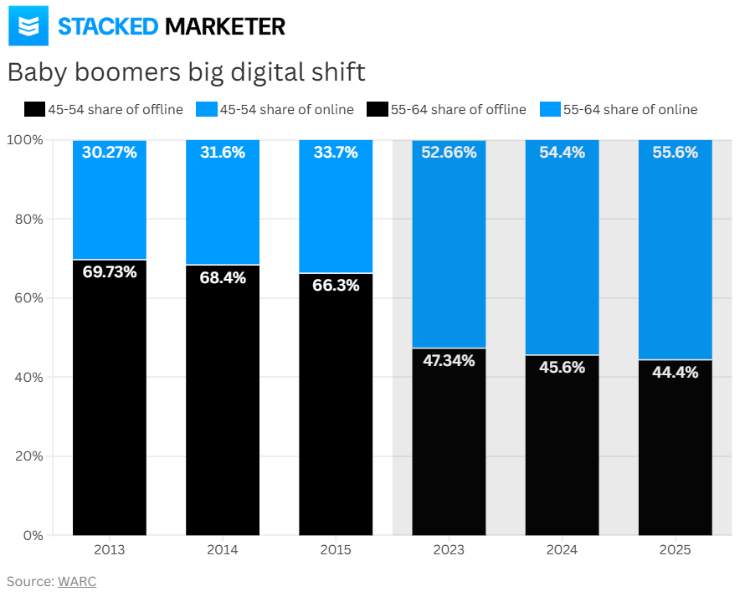
1️⃣ The 55 to 64 Group Crossed the Digital Line: In 2023, this age group hit a milestone where 52.66 percent of their activity happened online, surpassing offline for the first time. By 2025, that figure climbs to 55.6 percent, confirming the shift is not temporary.
2️⃣ The Change Has Been Rapid: Go back to 2013 to 2015 when this same cohort was aged 45 to 54. At that time, only 30 to 34 percent of their activity was online. In about a decade, their digital behavior has transformed completely.
3️⃣ Why This Matters for Marketers: Boomers are not digital beginners anymore. They are digitally fluent, financially strong, and spending meaningful time online. If your media plan still categorizes them as primarily traditional media consumers, your targeting is outdated.
4️⃣ What to Do Next: Update your personas and media assumptions. This group is streaming content, shopping online, and scrolling social feeds. Treat them as a digital-first segment with real purchasing power, not an offline audience that occasionally checks the internet.
The Takeaway
The “boomer digital adoption” story is no longer emerging. It’s here. If you want growth, move budget and messaging to match where 55 to 64 year olds actually spend time now: online.
As we prepare more "Growthful" content, we'd love to hear your thoughts on today's edition! Feel free to share this with someone who would appreciate it. 🥰