Control Your Brand Summary
🔍 Fix AI hallucinations about your brand, and target shoppers chasing more sales

Hey there 🧠
Ready for another day of staying ahead of the competition in the Growth race?
Oh and before we go ahead! If your friend sent this to you, be sure to subscribe here! So you don’t miss out on any editions.
Partnership with Tatari
TV works when your partner tells the truth

Everyone says, “We can unlock CTV for you.” Cool. Ask one question: can you show me, clearly, where my ads ran and what happened after?
Most platforms cannot, especially once you scale. That is when waste creeps in, CAC climbs, and you start blaming the channel instead of the partner.
Tatari helps you buy TV across linear and streaming with real visibility and outcomes measurement that holds up when spend grows.
- Cut wasted impressions by knowing real placements
- Scale reach without trading off supply quality
- Tie TV to business outcomes, not vanity reporting
Over 300 brands like Jones Road Beauty, Tecovas, Ridge Wallet, and Calm already advertise on TV with Tatari.
Imagine opening your next report and actually trusting it, then confidently increasing the budget because you can see the path to growth.
Don't forget to gut-check those shiny offers. Free ad credits? Performance guarantees? If it sounds too good to be true, it is.
Schedule a demo to get a clean TV launch roadmap today!
💡 Google AI Overviews: How to Remove or Suppress Harmful Content
If Google’s AI Overviews misrepresent your brand, surface outdated criticism, or hallucinate incorrect facts, you have two options: ignore it and hope it fades, or actively shape the signals the AI pulls from. Anthony Will outlines how to manage reputation when AI-generated summaries go wrong.
1️⃣ How AI Overviews Pull Information: AI Overviews draw from Google’s Knowledge Graph and other internal databases, but they also rely heavily on the open web and user-generated content. That means a credible press release can end up competing with an unverified forum post if both appear relevant to the query. The AI may treat multiple sources as equally eligible inputs, even when the quality differs.
2️⃣ When Removal Is Possible: If the harmful content is illegal, clearly defamatory, or infringes copyright, you may have legal options. You can pursue routes like DMCA takedown requests for copyright issues or legal claims for defamation when you can prove wrongdoing. In reality, these paths can be slow, expensive, and difficult to win. For most brands, they are not the primary solution.
3️⃣ Suppress Bad Sources With Stronger Signals: When you cannot delete the content, the practical move is to overwhelm it with higher-quality information. Publish accurate, positive, and verifiable content on trusted, high-authority domains. Use press releases, expert commentary, and consistent brand pages to create a larger pool of credible citations that AI Overviews can reference instead.
4️⃣ Use Structured Data to Clarify the Truth: Make it easier for Google to understand your brand by implementing Schema markup across key pages. Strengthen entity signals through clear author bios, consistent organization information, and visible credibility markers. Highlight strong reviews and proof points that support E-E-A-T so the AI has better structured facts to work from.
5️⃣ Monitor Early and Stay Consistent: You cannot fix what you do not track. Watch AI Overview results regularly so you can spot issues before they spread. Avoid aggressive or deceptive tactics, stick to documented facts, and build a long-term publishing plan you can sustain.
The Takeaway
You cannot always remove harmful content from Google’s AI Overviews, but you can influence what the system trusts. Flood the web with high-quality, authoritative signals, add structured data to reinforce your identity, and monitor proactively. Reputation management is now a publishing strategy, not a one-time cleanup.
💡 How Inflation Will Change Christmas Shopping Behaviour
Insights from stackedmarketer
Inflation is reshaping how people buy gifts. Shoppers are not necessarily spending less, but they are spending smarter. This season, the win is not just buying something nice. It feels like you found a deal and made a smart choice.
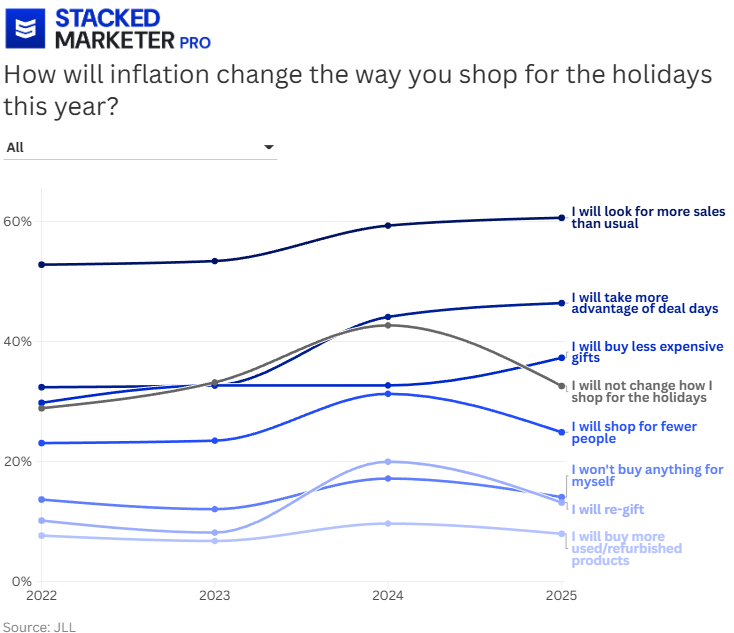
1️⃣ More Shoppers Are Actively Hunting for Deals: Over 60 percent of shoppers say they will look for more sales than usual this year, and that number has been rising steadily since 2022. At the same time, fewer people say they will keep shopping the same way. The trend is clear: bargain seeking is now the default mindset.
2️⃣ Shoppers Are Trading Down, Not Dropping Out: We are seeing more people choosing less expensive gifts at around 40 percent. Interest in shopping around specific deal days is also increasing. Even with budget pressure, the intent to buy remains strong. Consumers are simply making more calculated choices.
3️⃣ Regifting Is Not the Main Strategy: Despite the inflation squeeze, the “I will re-gift” mindset remains low. That suggests many buyers still want to give something new, but they want that purchase to feel justified through value.
4️⃣ What This Means for Marketers: Consumers want to feel like they outsmarted price hikes. Your messaging should match that psychological state. Focus less on luxury framing and more on smart buying, savings, and value for money.
5️⃣ What to Do Right Now: Shift your copy toward value language. Use phrases like “beat the price hikes” or “inflation-busting deals.” Promote deal day offers clearly, highlight savings transparently, and make the purchase feel like a win, not a splurge.
The Takeaway
Inflation is turning Christmas shopping into a strategy game. Brands that frame their offers as smart, value-driven choices will resonate most. Help customers feel like they found a deal, and they will still spend.
As we prepare more "Growthful" content, we'd love to hear your thoughts on today's edition! Feel free to share this with someone who would appreciate it. 🥰